
Book now

Post-operative rehabilitation

Structured rehabilitation after surgery — in four phases, from early mobilisation to returning to everyday life, work and sport.

Who is it for?

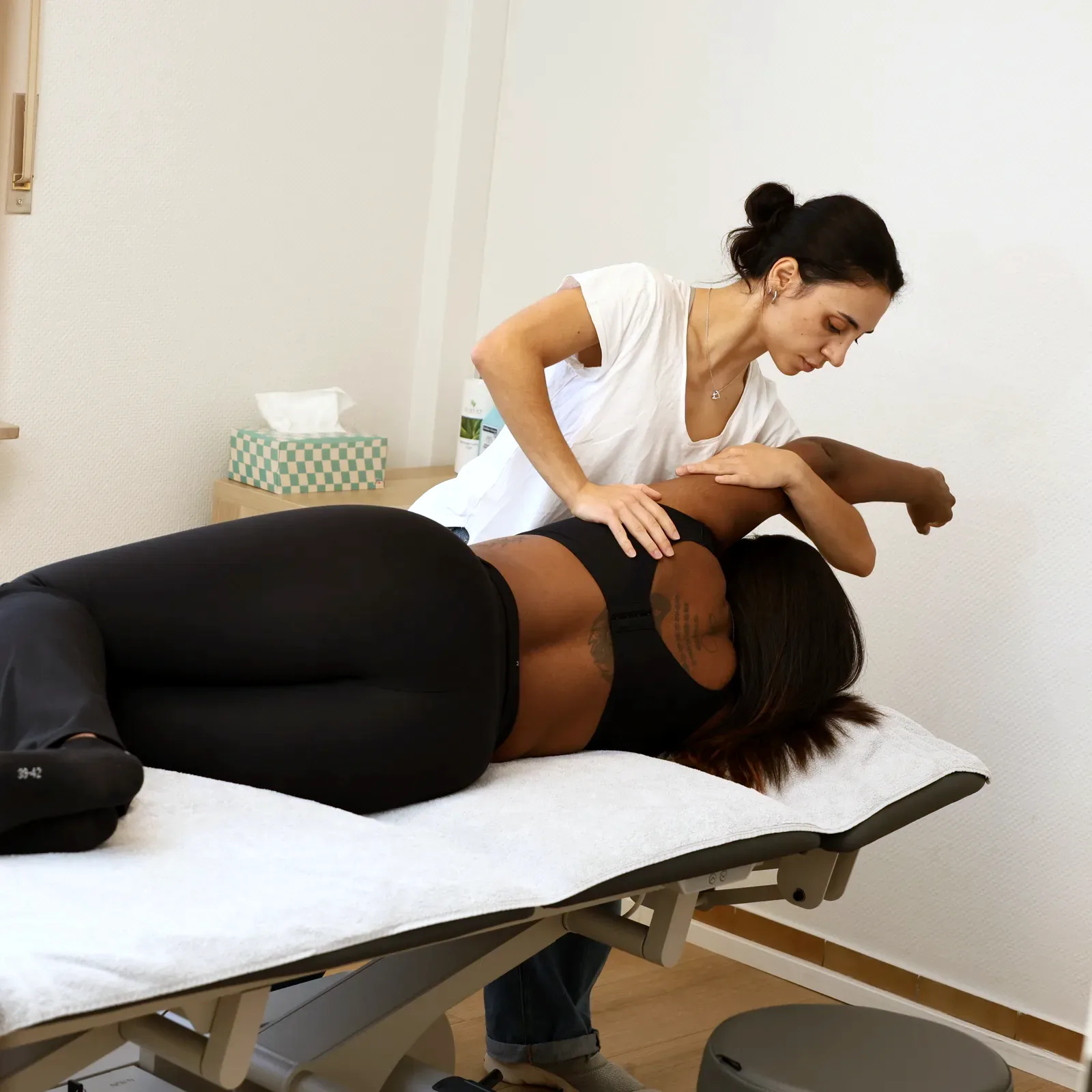
Post-operative rehabilitation at Therakura — shoulder mobilisation

The process — the four phases of rehabilitation

The exact process always depends on the type of operation, how healing progresses and your surgeon’s instructions. Weight-bearing clearances, movement limits, orthoses and precautions are consistently taken into account.

1 · Protection and early phase

Reducing pain and swelling, protecting the operated structures, safely activating circulation and mobility, targeted muscle activation — plus getting up, walking and climbing stairs safely and using crutches or orthoses. After many operations, physiotherapy begins early; the exact start date and permitted load are set by the surgical team.

2 · Mobility and control phase

Gradually restoring mobility, improving joint and muscle control, gait training and normalising everyday movements, coordination and balance training, scar treatment once the wound has healed sufficiently — plus building a suitable home programme.

3 · Building strength and load capacity

Progressive strength training, medical exercise therapy, stability and endurance, single-leg stance, balance and reactive ability — preparing for everyday life, work and longer periods of exertion, with a controlled transition to more complex movements.

4 · Return to work and sport

Work- or sport-specific load building, strength, jumping, running and change-of-direction training (where cleared), functional tests to assess load capacity and a gradual return to training and competition — including strategies to prevent re-injury. Returning to sport should not depend solely on a fixed timeframe: what matters is healing progress, strength, mobility, control and the demands of the particular sport.

Treatment approach

We start by discussing the course of your operation, your doctor’s instructions and your personal goals. We then examine mobility, strength, swelling, gait pattern, coordination and functional load capacity. Depending on the phase, we combine active mobilisation, progressive strength building, manual techniques, gait training, balance training, medical exercise therapy, scar treatment and personalised home training.

Our aim is not just a short-term improvement in mobility, but to restore your independence, load capacity and confidence in your own body as safely as possible. If you have severe or worsening pain, new numbness or signs of paralysis, please see a doctor first.

If you develop painful swelling in one leg or calf, please contact your doctor straight away; if you experience sudden shortness of breath or chest pain, call 112 immediately.

Duration & fees

Standard sessions last around 30 minutes, and the standard physiotherapy rates apply. Frequency depends on the operation, the prescription and the rehabilitation phase. Longer training or performance sessions outside prescribed physiotherapy can be offered as a separate self-pay service if required.

Reimbursement: Up to 100% CNS reimbursement possible after musculoskeletal surgery (deadlines apply — details on the reimbursement page). All details & insurer links →
Available at these locations

Your contacts

Frequently asked questions

When should I start physiotherapy after my operation?

That depends on the operation and your surgeon’s instructions. After many procedures, rehabilitation starts early, sometimes while you are still in hospital. Book your first appointment as early as possible and bring your doctor’s instructions with you.

What should I bring to my first appointment?

Please bring your prescription, the surgical report, any imaging, your post-operative treatment plan and information on weight-bearing or movement limits. Please also bring orthoses, crutches or any other aids you use.

Can I start treatment before my stitches have been removed?

Rehabilitation can often begin beforehand. The wound is protected and not treated directly. Which exercises and loads are allowed depends on the procedure and your doctor’s instructions.

Do I have to accept pain during exercises after surgery?

Some soreness or a feeling of exertion can occur during rehabilitation. However, severe, increasing or persistent pain should not be ignored. We adapt the load to your response and to how your healing is progressing.

When can I put full weight on it again?

Clearance for full weight-bearing is given by your surgeon and depends on the operation and on tissue healing. Particularly after tendon, ligament, cartilage and bone surgery, clear load limits may be needed for a time.

How long does rehabilitation take?

It varies greatly. After minor arthroscopic procedures, rehabilitation can be relatively short, whereas after cruciate ligament reconstruction, tendon repair, joint replacement or complex fractures it can take several months. What matters is not just the time that has passed, but the function you have regained.

When can I go back to work?

That depends on the operation and the physical demands of your job. A desk job places different demands on you than physical work, standing for long periods or heavy lifting. We prepare you step by step for the specific demands of your work.

When can I drive again?

Clearance to drive should be discussed with your treating doctor. You must be able to control the vehicle safely and react quickly in an emergency. Painkillers, orthoses, restricted movement or reduced load capacity can impair your fitness to drive.

When can I return to sport?

The return is gradual — first general load building, then sport-specific movements and finally training or competition. After more complex procedures, the decision should also be based on objective functional criteria.

Are home visits possible after surgery?

Yes, if you are not yet able to come to the practice for medical reasons. For the costs to be covered, the medical necessity of the home visit must be stated on the prescription; the home visit must take place in Luxembourg.

Your path to lasting health starts here.

Book your appointment online – in Schuttrange, Echternach or Contern.

Book an appointment