 ®
Treatment approach
We begin with a detailed consultation and examination. This allows us to distinguish whether your symptoms appear appropriate for physiotherapy or should first be assessed by a doctor, neurologist or ENT specialist.
Depending on your condition, we examine the mobility and load capacity of the cervical spine, the neck, shoulder, facial and chewing muscles, posture, breathing and movement patterns, balance and gait stability, eye movements and the interplay between eyes and head, as well as whether dizziness is triggered by certain positions or movements.
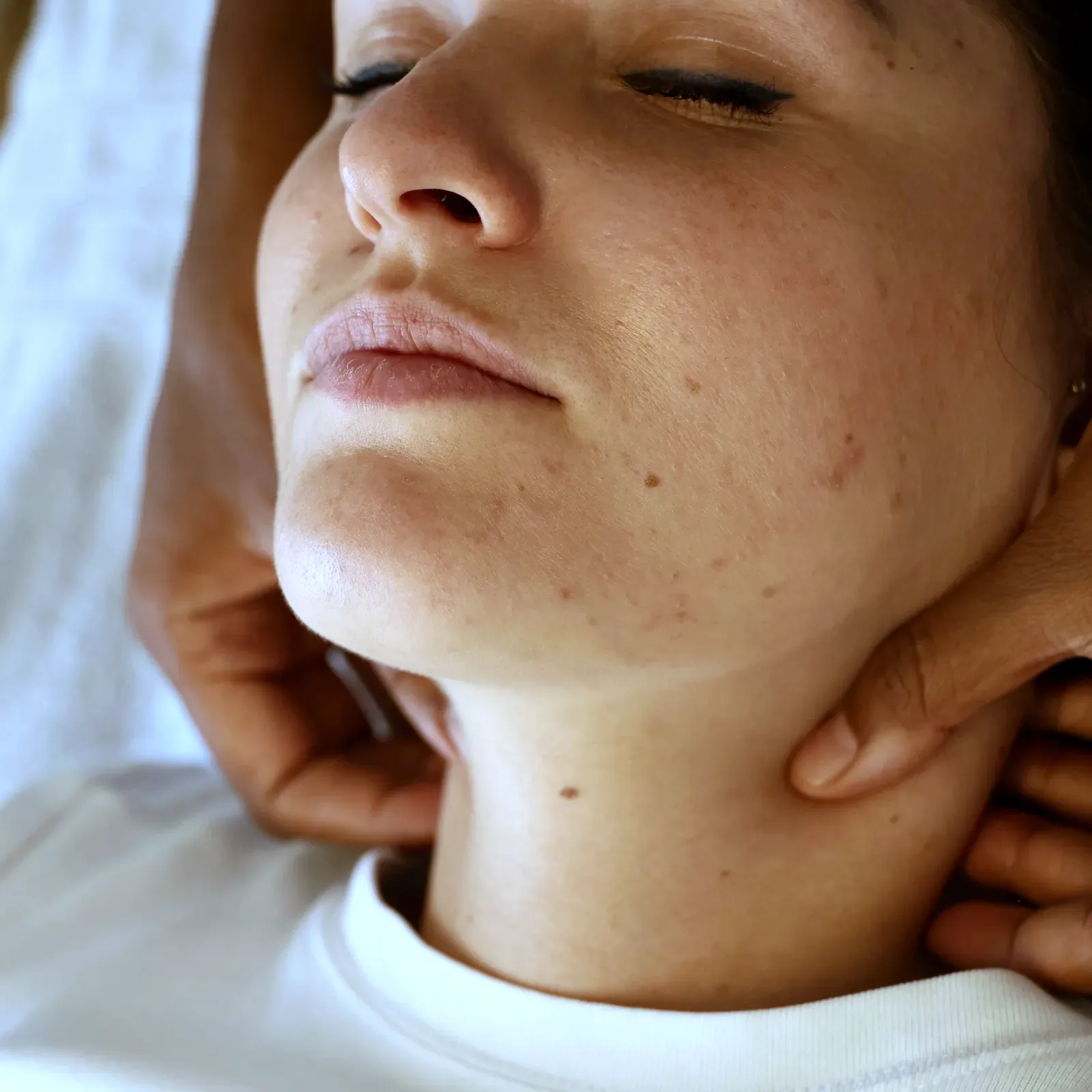
Treatment may include manual techniques for the cervical spine and muscles, active exercises, balance, coordination and gait training, gaze stabilisation and eye–head exercises, habituation exercises for movement-related dizziness, and targeted repositioning manoeuvres for confirmed positional vertigo — complemented by a personalised home exercise programme. A headache diary can help to systematically record frequency, duration, accompanying symptoms and possible triggers.
Migraine
For migraine, physiotherapy does not replace medical or drug treatment. It can, however, specifically address accompanying symptoms such as neck tension, movement restrictions, muscle overload or balance problems. Migraine is a neurological condition and should be assessed by a doctor if attacks are frequent, severe or have not yet been diagnosed.
Complementary osteopathic examination
For complex or recurring symptoms, an osteopathic examination can be added. This looks not only at the head, jaw and cervical spine, but also at possible functional connections with the fasciae, nervous system, organs and other body systems. The osteopathic examination complements medical assessment but does not replace it.
Who provides the treatment?
Carine Ludes (Schuttrange) — migraine and tension-type headache therapy. Giuseppina Sagona (Echternach) — examination and treatment of dizziness that is suitable for physiotherapy. Ken Roeser (all locations) — complementary osteopathic examination for complex or recurring conditions.
Duration & fees
Physiotherapy: around 30 minutes, standard rates. Osteopathy: around 60 minutes, standard osteopathy rates — a self-pay service that many supplementary health insurance policies cover in full or in part (see the reimbursement page).
Reimbursement: Physiotherapy with a prescription is reimbursable by the CNS; the complementary osteopathic examination is a self-pay service (many supplementary health insurance policies contribute). All details & insurer links →